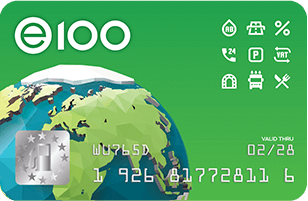
Cargo ferry crossings with the E100 card
- Extensive network of ferry routes
- Convenient payment via fuel card
- Cost control in a single system
- 24/7 hotline support
25 000+ clients
700+ ferry routes
Access to a network of 60+ ferry operators
Benefits of settling ferry crossings with E100
E100 offers flexible connections from the Baltic Sea to the Caspian Sea and the Mediterranean Sea through agreements with the largest ferry operators. Pay for ferry transport, fuel, and tolls in a single system—simply, transparently, and cashlessly.
One card – the entire route
Fuel, tolls, and ferry – all settled in a single dashboard
Transparent billing
Full expense tracking in the E100 Customer Dashboard
Simplified accounting
One consolidated invoice instead of multiple documents: fuel + tolls + freight ferry
Convenient booking
Efficient ferry space reservation and clear billing terms—no unnecessary paperwork
24/7 support
Round-the-clock assistance for drivers and transport managers
Major ferry routes
Baltic Sea
- Świnoujście (PL) – Malmö (SE)
- Gedser (DK) – Rostock (DE)
- Liepāja (LV) – Travemünde (DE)
Daily crossings for truck transport
Mediterranean Sea
- Messina (IT) – Villa San Giovanni (IT)
- Salerno (IT) – Messina (IT)
- Barcelona (ES) – Palma (ES)
Key connections between continental Europe and the Mediterranean islands
English Channel and Ireland
- Dover (UK) – Dunkirk (FR)
- Calais (FR) – Dover (UK)
- Cherbourg (FR) – Dublin (IRL)
Fast and regular crossings connecting the United Kingdom and Ireland with continental Europe
Caspian Sea
- Alyat (AZ) – Kuryk (KZ)
- Alyat (AZ) – Turkmenbashi (TM)
Strategic Caspian connections
Can’t find your route?
Thanks to our partnerships with numerous operators, we offer access to hundreds of ferry connections in Europe and beyond. Contact us—we’ll find a solution tailored to your route.
How to book a ferry crossing?
Booking a cargo ferry crossing with E100 is quick and convenient. Simply fill out the contact form — our team will reach out to you and prepare a quote.
Would you like to use E100 ferry crossing services?
Fill out the form and we'll prepare an offer tailored to your fleet.
Submit an application
FAQ
How many commercial ferry crossings in Poland handle cargo traffic?
There are several popular commercial ferry crossings in Poland that handle cargo traffic. Among E100’s offerings, the most popular routes — from Świnoujście to Sweden and from Gdynia to Finland — are particularly important.
How much does a ferry crossing with a truck cost (what determines the cargo price)?
The cost of a freight ferry crossing is calculated individually for each specific vehicle, route, and date. Each route has its own price, as the cost depends, among other factors, on the length and duration of the crossing. In practice, the price of a crossing for a truck often starts at several hundred euros. On longer or more demanding routes, it can reach around 900 euros or more.
The price also depends on the length of the truck-trailer combination, the number of drivers, the type of cargo, and any additional transport requirements. ADR shipments, refrigerated cargo, oversized loads, space availability, and additional fees applicable to a given route can also affect the price. Therefore, the final price of the crossing applies to a specific case.
How do I book a cargo ferry ticket for a wide load or refrigerated truck?
The booking process depends on the selected route. E100 customers can review the booking rules for available ferry crossings in the Customer Portal. For articulated trucks, refrigerated trucks, ADR shipments, or special cargo, additional information regarding the vehicle and the cargo being transported may be required.
What documents (CMR, trailer documents, customs documents) are required for commercial ferry clearance?
The scope of required documents depends on the selected route. For Baltic Sea crossings, an extensive set of customs documents is usually not required. In most cases, basic information about the vehicle, trailer, driver, and reservation is sufficient.
For special routes, such as crossings across the Caspian Sea, additional documents may be required. These include, among others, the CMR, the driver’s passport, a packing list, an invoice for the cargo, the registration certificates for the tractor and trailer, and customs documents, if required for the specific shipment.
When are freight ferry tickets cheapest for transport companies?
The price of a crossing may vary depending on the route, date, and day of the week. For Baltic routes from Świnoujście, the best prices are usually available on Thursday, Friday, and Saturday.
On which Baltic routes is the largest number of commercial ferry connections available for transport companies?
Most cargo ferry connections are concentrated on a few routes:
- Poland – Sweden – the most sailings and operators (including the Świnoujście – Trelleborg or Ystad ferry crossing, and Gdynia)
- Karlskrona, Gdańsk–Nynäshamn
- Germany – Sweden —high volume (Rostock–Trelleborg, Travemünde–Sweden)
- Finland – Germany / Western Europe — fewer routes, but crucial for heavy cargo
- Sweden – Finland / Baltic Sea – lower share of TIR trucks, but a growing segment
- Highest density and frequency: Poland – Sweden
What does a ferry crossing break mean on the tachograph?
This indicates a driver’s rest period during a ferry or train crossing.
Does a ferry trip count as a driver’s break and rest period? How do you properly take a ferry break?
Yes, a ferry trip can count toward a driver’s rest period if the conditions specified in EU regulations are met. The driver should have access to a rest area and properly set the ferry/train mode on the tachograph.
How long does a cargo ferry have to sail for a ferry break to count?
There is no specified minimum voyage time required. EU regulations do not specify a particular number of hours; the key requirement is that the rest conditions are met. For time spent on the ferry to count as rest, the driver must have access to a cabin or berth. Furthermore, the driver may not perform any other work-related activities and must have the ferry/train mode set on the tachograph. In practice, shorter voyages usually allow only for a partial rest period. Longer crossings, however, may allow for a full rest period — so it is not the duration of the crossing that matters, but rather compliance with rest requirements.
What does ferry check-in look like for truck transport?
Ferry check-in involves arriving at the terminal, checking in, verifying the reservation, and, if necessary, inspecting the vehicle and cargo documents. Once the formalities are complete, the driver receives instructions on how to board the ferry. Check-in details may vary depending on the route, port, type of cargo, and terminal requirements.
How long before the ferry crossing should you check in (trucks and ADR)?
A tractor-trailer should arrive at the port well in advance of departure. In practice, for truck transport, it is advisable to plan to arrive an average of 2–3 hours before the voyage. For ADR/IMO shipments, special cargo, or unmanned trailers, a longer time buffer is recommended.
How far in advance must a tractor-trailer be at the port before departure?
It should arrive at the port well in advance of departure. In practice, for truck transport, it is advisable to plan to arrive an average of 2–3 hours before the voyage. For ADR/IMO shipments, special cargo, or driverless semi-trailers, a longer buffer is recommended.