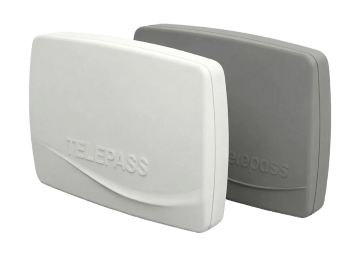
The DM03 on-board unit uses DSRC microwave technology and is designed for electronic toll payments across Europe. It is currently available in France, Spain, Portugal, Austria, Italy and Poland (A4), as well as at the Liefkenshoek Tunnel in Belgium.
The DM03 Light is a multi-purpose toll device designed for light vehicles with up to two axles, a gross vehicle weight of less than 3.5 tonnes and a height of up to 3 metres. It is therefore suitable for passenger cars and vans.
With the DM03, you can pay tolls in France, Italy, Spain and Portugal, as well as for the Villa San Giovanni ferry in Italy.
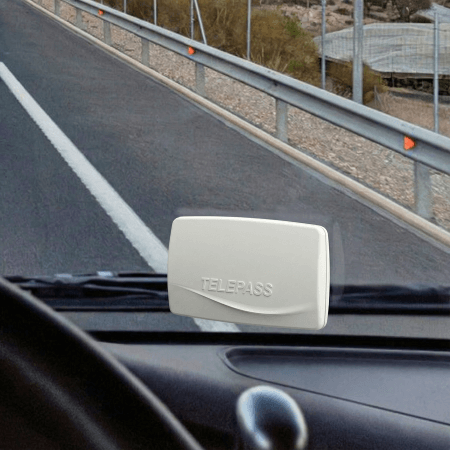
Both devices are wireless and can be easily mounted on the vehicle’s windscreen. Tolls are recorded automatically, while the full transaction history can be viewed in real time via your E100 account.
Benefits of the DM03/DM03 Light
Easy toll payments
There’s no need to carry cash or stop to pay tolls. The device automatically records your toll transactions as you travel.
Speed and convenience
The DM03 / DM03 Light enables seamless toll payments without the need to stop at toll booths. Simply attach the device to the vehicle’s windscreen and drive.
Real-time transaction monitoring
Track all your transactions in real time via the E100 Customer Portal, giving you greater visibility and control over your road-related expenses.
VAT refunds on tolls
Using an on-board unit can make it easier to claim VAT refunds on eligible tolls across Europe. Our specialists will tailor the refund process and terms to your business needs.
How to order the DM03/DM03 Light?
Simply complete the contact form. Our representatives will prepare an offer tailored to your business and register you for the relevant toll services.
Complete the application form
Device coverage

DM03
For vehicles over 3.5 t
FR, ES, PT, IT

DM03 Light
For vehicles under 3.5 t
FR, ES, PT, IT, HR
FAQ
As a general rule, the tax treatment of toll charges varies by country. Depending on the toll system, accounting documents may be provided by the system operator, a service provider appointed by the operator, or the fleet card issuer.
Please note that E100 provides a document titled ‘Statement of Amounts Due’. This document is for information and settlement purposes only and is not intended for use in VAT returns or declarations to the tax authorities. The costs of road tolls should be recorded on the basis of invoices issued and sent directly by the relevant suppliers or operators, depending on the type of device selected.
An on-board unit is a device that enables the electronic payment of tolls for journeys on tolled roads. It records the vehicle’s location data or transmits data to the toll system via radio signals. The vehicle is assigned to the unit, which automatically calculates the toll due for the journey.
An on-board unit offers many benefits to both drivers and fleet owners. Drivers do not have to stop at toll collection points or carry cash, and they do not need to keep track of individual toll payment invoices.
If the device requires a power supply, it must be fitted to the vehicle and connected either permanently or to the vehicle’s 12V socket. Installation instructions are included with each device.
The cost of using an OBU depends on the provider and the toll system in which it operates. The E100 range includes a variety of OBU models, including devices for domestic and multi-country toll systems.
An ELS (External Location System) is permanently installed in the vehicle and requires professional fitting. One advantage is that it does not need to be charged.
An OBU (On-Board Unit), on the other hand, is a portable device. It can be connected to the vehicle’s 12V socket or OBD port and can also be moved between vehicles.
EETS (European Electronic Toll Service) is a system that enables road users to pay tolls across multiple EU countries using a single contract and, where required, a single on-board unit. Its aim is to simplify and automate toll payments.
When choosing an OBU, it is therefore worth considering the technologies it uses, such as GNSS (Global Navigation Satellite System) and DSRC (Dedicated Short-Range Communication).
Many European countries have toll motorways and/or expressways. Toll requirements vary by country, so the list of toll roads should be checked on the website of the relevant operator or national authority.